
Cultural Atlas
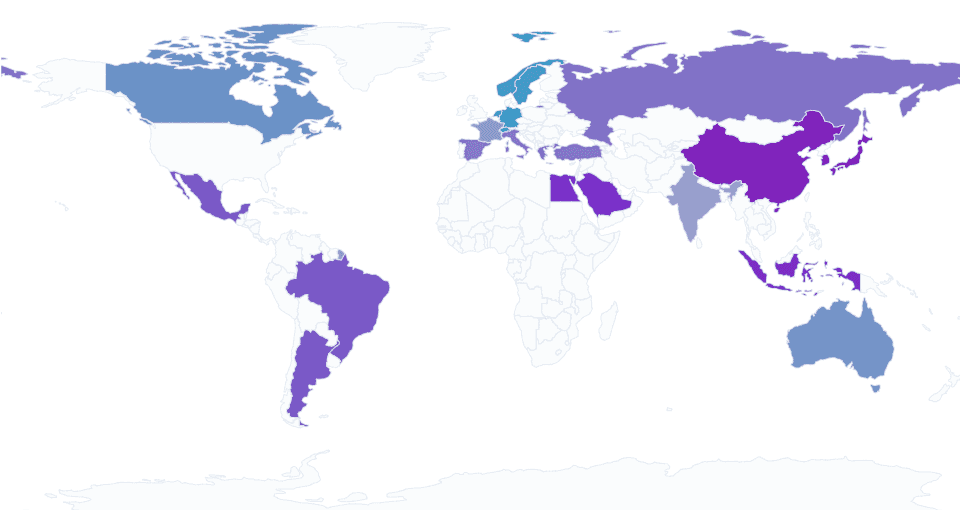
Compare countries across eight behavioral scales with academic communicating scores and interactive radar charts.
Cultural Atlas visualizes cross-cultural differences on communicating, evaluating, persuading, leading, deciding, trusting, disagreeing, and scheduling. Communicating scores are grounded in Hall's high-/low-context research and Hofstede's Individualism index; select any two of 26 countries to compare.
How to read the scales
Each scale runs from 0 to 99. Lower scores sit closer to the first pole, while higher scores sit closer to the second pole. These are tendencies, not rules for every individual.
Communicating
How much meaning is carried by explicit words versus shared context, tone, and nonverbal cues.
People spell out expectations, background, and next steps directly.
People rely more on shared history, implication, status, and reading between the lines.
Evaluating
How openly people give criticism or corrective feedback.
Criticism is stated plainly and may be separated from the relationship.
Criticism is softened, implied, or delivered privately to protect harmony and face.
Persuading
Whether arguments usually begin with theory and principles or with concrete cases and action.
People build the case from concepts, logic, and underlying rules before applications.
People start with examples, practical outcomes, and recommendations before broader theory.
Leading
How much distance is expected between leaders and the people they lead.
Managers are expected to be accessible, consultative, and relatively informal.
Authority, rank, and clear status differences are expected and respected.
Deciding
How decisions are typically made once a group or organization needs to commit.
Decisions take longer up front because broad input and buy-in matter.
A leader or small group decides, often allowing faster commitment after consultation.
Trusting
What people usually rely on when deciding whether someone is trustworthy.
Trust grows from reliability, competence, contracts, and doing good work together.
Trust grows from personal rapport, shared meals, introductions, and long-term relationships.
Disagreeing
How comfortable people are with open debate, challenge, and conflict in group settings.
Disagreement can be direct and public without necessarily damaging the relationship.
Disagreement is handled carefully, indirectly, or offline to preserve harmony.
Scheduling
How people treat time, plans, deadlines, and interruptions.
Schedules, punctuality, sequencing, and deadlines are treated as firm commitments.
Plans adapt more readily around relationships, changing priorities, and context.